Millet farmers and two routes into India: the origin of Sino-Tibetan
By Vāgṛtam. Published .
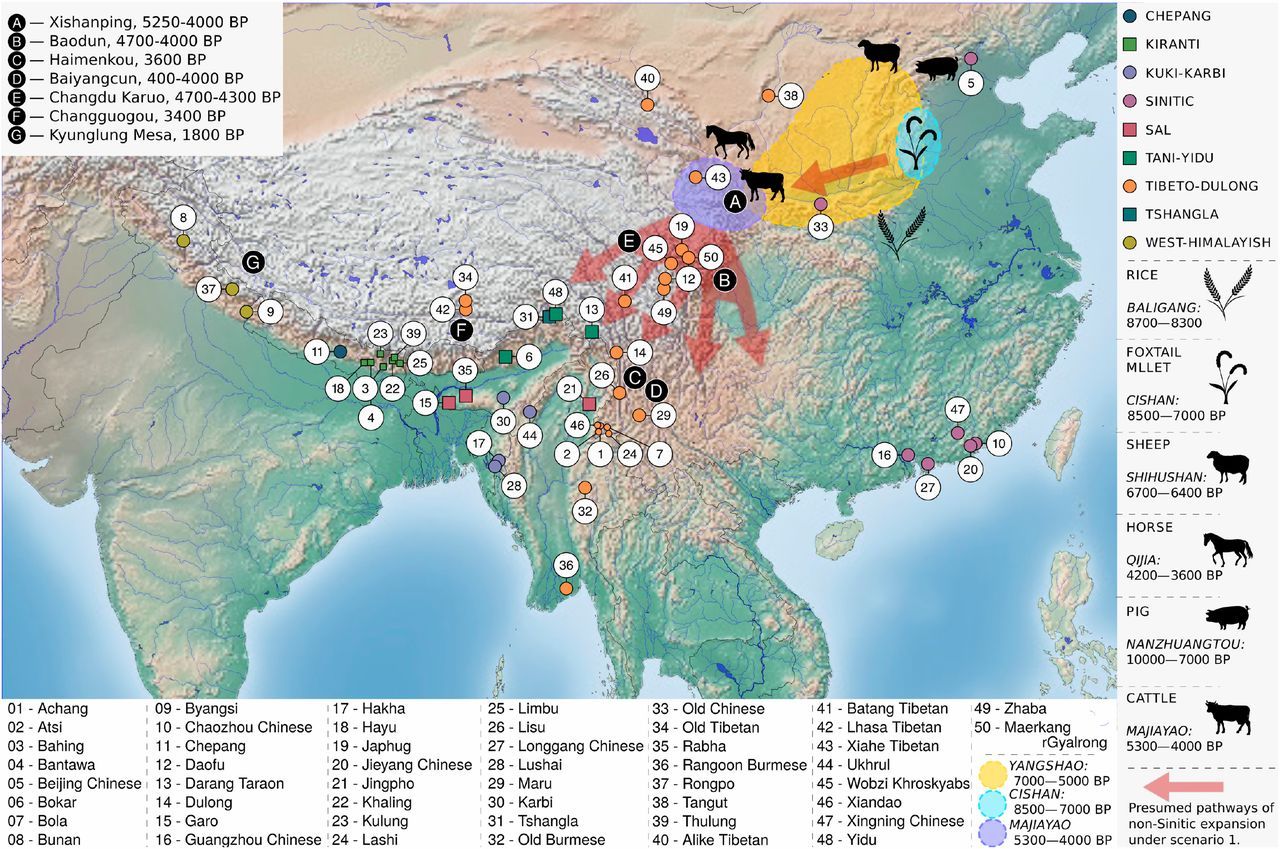
If you speak Meitei, Bodo, Ladakhi or Tibetan, you speak a Sino-Tibetan language (ST). The ST family, is the second largest language family in the world in terms of the number of speakers, comprising some 500 languages spread over China, Burma, Northern Thailand, Bangladesh, North-Eastern India, Nepal, Bhutan, and the northernmost states of India and Pakistan (Sikkim, Uttarakhand, Himachal Pradesh, Ladakh and Baltistan)[9] with Sinitic languages (or ‘Chinese dialects’), constitutes the overwhelming majority of ST language speakers[1].
The Origin in China
The leading hypothesis is the the Renfrew–Bellwood model of demic diffusion, according to which the expansion of agriculture is largely correlated to that of language families with the homeland as where the key crops were first cultivated. For Sino-Tibetans, the crop is millet. Foxtail and broomcorn millet were both domesticated in northern China, and many linguists favour the view that Sino-Tibetans arose among agricultural societies there[2]. Language studies back this up where two independent teams built family trees from shared vocabulary. One concluded that the family began with north Chinese millet farmers, linked to the late Cishan and early Yangshao cultures[1] and the other used a larger sample of 131 languages and found that the family first split into Sinitic and Tibeto-Burman. It also found that the family’s origin coincides with the onset of millet-based agriculture[3].
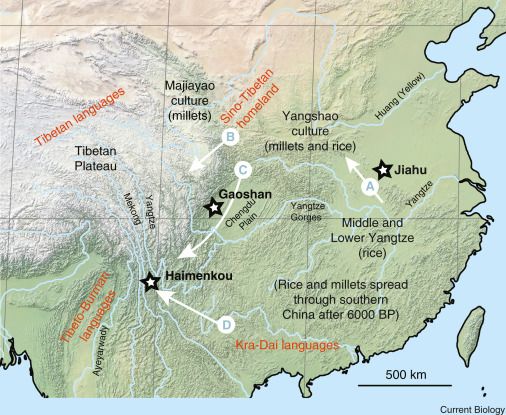
A major ancient-DNA study concluded that Yellow River Basin farmers probably spread Sino-Tibetan languages, and their ancestry makes up about 84% of the gene pool in some Tibetan groups and contributes about 59–84% to Han Chinese[4]. Other work found that high-altitude Tibeto-Burman speakers descend mainly from Neolithic Yellow River farmers[5]. A Y-chromosome study of 15,563 individuals links the expansion of Yellow River millet farmers to the formation of Sino-Tibetan peoples and to permanent settlement of the Tibetan Plateau[6].
Migrating into Indian Subcontinent
Ancient DNA from 11 skeletons at Gaoshan in Sichuan and Haimenkou in Yunnan[7] shows that both groups derive about 90% of their ancestry from Neolithic Yellow River farmers[7]. A commentary on that study concludes that these people probably spoke Tibeto-Burman languages, separate from the Sinitic languages that developed closer to the Yellow River[8]. The combination of linguistics, archaeology and genetics help us conclude that the evidence fits a series of migrations of millet farmers from the Yellow River basin along two routes[2].
- The Plateau route - The key clue is the cord-held stone harvesting knife. It appears first along the Yellow River, then in Qinghai, northwest Sichuan, East Tibet, Central Tibet, and finally Kashmir and Swat[2], but it is largely absent from Central Asia and Northeast India[2]. The scholars argue this reflects people moving, not just trade, for three reasons:
-
The Kashmir and Swat knives were made from local stone, which indicates local craftsmen[2].
-
Sites get younger moving west, so the movement ran east to west[2]. Crops, house styles, hairpins and tools together, with the linguistic evidence, more probably reflect the movement of peoples[2]. One example is that a hairpin style from the Shang-period site of Yinxu strongly resembles hairpins from Swat[2].
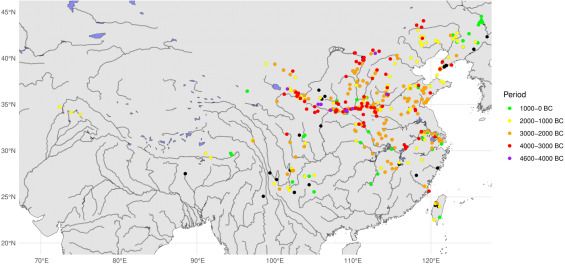
The genetic evidence says that individuals with Yellow River-related ancestry turn up as far west as Mustang in Nepal[2]. The scholars link two language groups to this route, West Himalayish, spoken only about 100 km from the Kashmir sites, and Bodish, which includes Tibetic, East Bodish and Tamangic[2]. Bodish languages also share a word for ‘barley’[2], which fits the spread of barley farming on the Plateau.
- The southern route - The second route runs through Yunnan and northern Myanmar into Assam. The distribution of shouldered stone spades suggests a spread from Yunnan into Northeast India[2]. Ancient DNA from Haimenkou found no rice-farmer ancestry, suggesting these people adopted rice farming without genetic assimilation[7]. The authors think this route could account for some migrations into northern India, especially groups south of the Lohit River, such as Sal and Kuki-Chin, which are spread across India and Myanmar[2]. The Jinghpo language is a living reminder of the corridor, spread in patches across a 400 km zone from Yunnan through Kachin State in Myanmar to Assam[2].
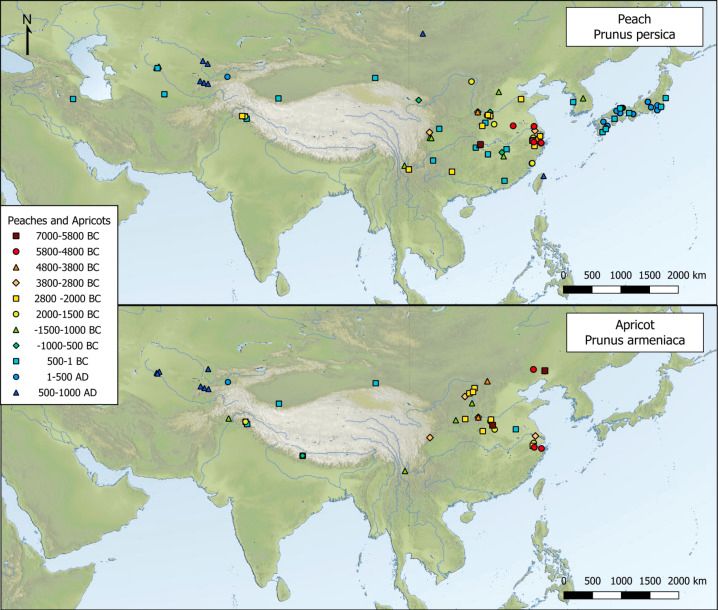
The words and cultural memory preserve the connection. Puroik words for ‘pig’ and ‘foxtail millet’, in a small language of Arunachal Pradesh, match Sino-Tibetan roots found in languages of China[2]. The Tani languages have a reconstructible word for ‘peach’ matching Tibetan and other branches[2], which the scholars take as a sign that peach spread partly with Sino-Tibetan-speaking people[2]. Even oral tradition may hold a trace: the Apatani of Arunachal Pradesh say they came from Tibet[2].
Sources
- Dated language phylogenies shed light on the ancestry of Sino-Tibetan . Laurent Sagart, Guillaume Jacques, Yunfan Lai, Robin J. Ryder, Valentin Thouzeau, Simon J. Greenhill, Johann-Mattis List, Proceedings of the National Academy of Sciences 116 (21) . Published . Secondary source
- Linguistic, archaeological and genetic evidence suggests multiple agriculture-driven migrations of Sino-Tibetan speakers from Northern China to the Indian subcontinent . Guillaume Jacques, Chris J. Stevens, Quaternary International . Published . Primary source
- Dated phylogeny suggests early Neolithic origin of Sino-Tibetan languages . Hanzhi Zhang, Ting Ji, Mark Pagel, Ruth Mace, Scientific Reports 10 . Primary source
- Genomic insights into the formation of human populations in East Asia . Chuan-Chao Wang et al., Nature 591 . Secondary source
- Peopling History of the Tibetan Plateau and Multiple Waves of Admixture of Tibetans Inferred From Both Ancient and Modern Genome-Wide Data . Guanglin He et al., Frontiers in Genetics 12 . Published . Primary source
- Multiple Human Population Movements and Cultural Dispersal Events Shaped the Landscape of Chinese Paternal Heritage . Mengge Wang et al., Molecular Biology and Evolution 41 (7) . Published . Primary source
- Ancient genomes reveal millet farming-related migration from the Yellow River into southwest China . Le Tao, Haibing Yuan, Kongyang Zhu et al., Current Biology 33 (22) . Published . Primary source
- Archaeogenetics: Tracing ancient migrations from the Yellow River . Peter Bellwood, Current Biology 34 (1) . Published . Secondary source
- Tibeto-Burman languages and classification . David Bradley, Pacific Linguistics . Primary source